
If you’ve ever heard someone say, “Construction always goes over budget,” you’re not alone. It’s a common complaint, whether it’s a home renovation, a commercial building, or a large infrastructure project. But here’s the thing: most budget problems don’t start on the job-site. They start at the planning table, when costs are guessed, rushed, or calculated without enough detail.
That’s exactly where What is Construction Cost Estimating becomes a game-changer.
Construction cost estimating is the process of predicting the total cost of a project before construction begins. It’s not just about adding up material prices and labor hours. A proper estimate considers everything that can affect the final cost, materials, labor, equipment, subcontractors, permits, overhead, timelines, inflation, and even unexpected risks like weather delays or supply chain issues. In plain terms, it answers one crucial question: “How much will this project really cost to complete?”
And that answer matters a lot.
Accurate cost estimating helps owners decide if a project is financially possible. It helps contractors bid competitively without risking losses. It helps project managers control spending and track progress. And it helps everyone, from stakeholders to suppliers, stay on the same page. When estimating is done correctly, projects run smoother, disputes reduce, timelines improve, and profits stay protected.
On the flip side, inaccurate estimating can create serious trouble. If you underestimate, you may run out of funds mid-project, face delays, or cut corners that hurt quality. If you overestimate, you might lose bids or discourage clients from moving forward. Either way, bad estimates cost time, money, and trust.
In this guide, you’ll learn exactly what construction cost estimating is, the different types of estimates used at each project stage, and why the importance of accurate cost estimating can’t be overstated in today’s fast-changing construction market. We’ll also walk through the step-by-step process, tools used by professionals, common challenges, and best practices that help produce estimates that are reliable—not just “close enough.
What is Construction Cost Estimating?
At its core, it is the systematic process of predicting the total cost required to complete a construction project. This includes calculating materials, labor, equipment, overhead, and contingency expenses.
Construction cost estimating helps contractors, developers, and project managers understand the financial requirements before the first brick is laid. It ensures that projects remain profitable and financially feasible.
Why Cost Estimation Matters in Construction Projects?
Without accurate estimating, projects can quickly spiral out of control. Budget overruns, disputes, delays, and even project failure often result from poor cost planning.
Accurate construction cost estimating provides:
- Financial clarity
- Risk mitigation
- Informed decision-making
- Better project planning
- Improved stakeholder confidence
Simply put, it’s the backbone of every successful construction project.
Key Components of Construction Cost Estimating
Direct Costs (Labor, Materials, Equipment)
Direct costs are expenses directly linked to construction activities. These include:
- Construction materials (cement, steel, wood)
- Labor wages
- Machinery and equipment rental
These costs form the largest portion of the total estimate.
Indirect Costs (Overheads, Permits, Utilities)
Indirect costs are not directly tied to specific construction tasks but are essential for project completion:
- Site security
- Insurance
- Permits and legal fees
- Administrative expenses
Ignoring these can lead to serious budget miscalculations.
Contingency and Risk Allowances
Every construction project carries risk. Weather delays, price fluctuations, or design changes can increase costs. A contingency fund (typically 5–15%) protects against unforeseen expenses.
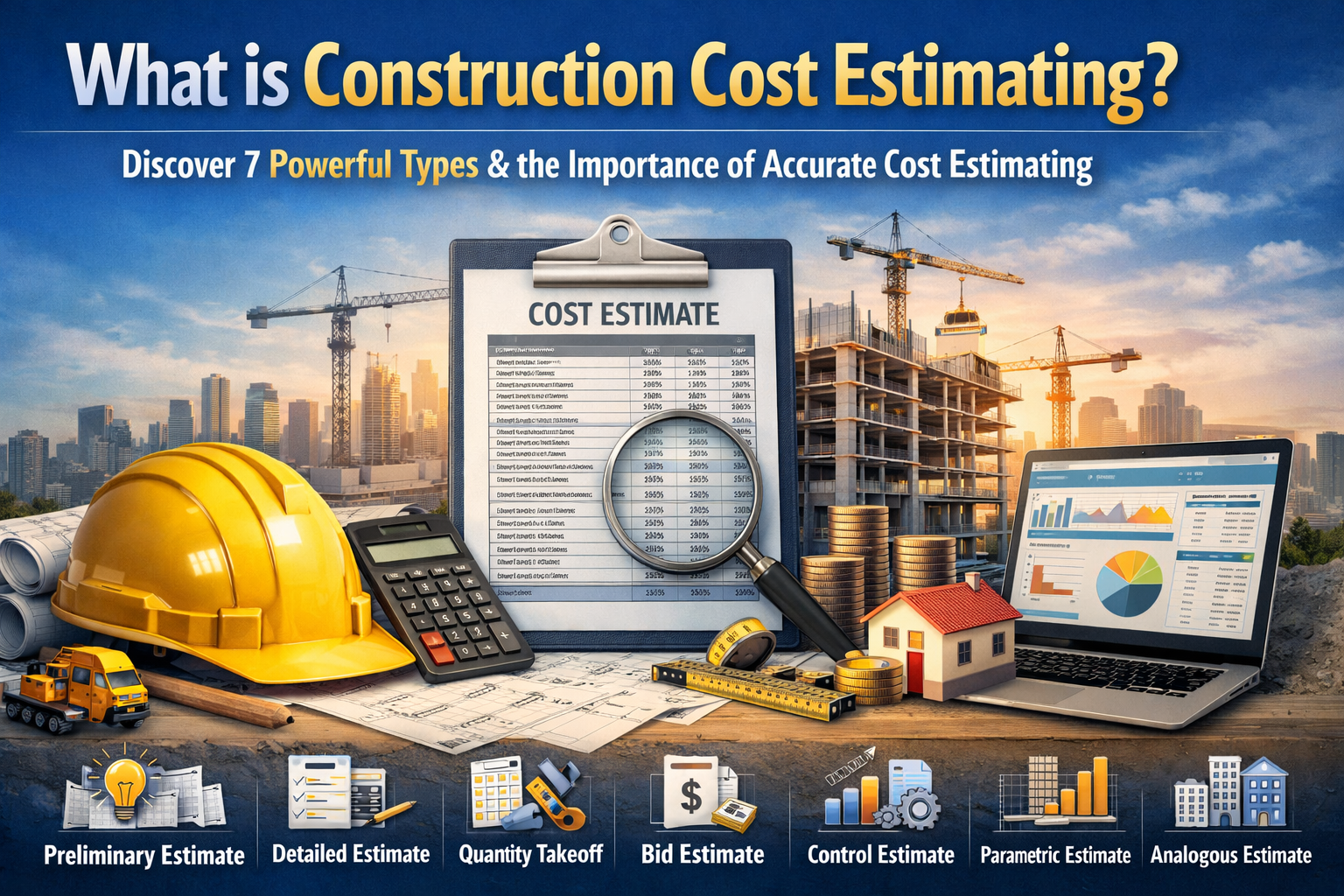
7 Major Types of Construction Cost Estimating
Understanding the different types helps answer the question: What is Construction Cost Estimating in practical terms? Each type serves a specific purpose depending on the stage of the project. Let’s explore them in depth.
1. Preliminary (Conceptual) Estimate
A Preliminary Estimate, also known as a Conceptual Estimate, is prepared at the very beginning of a project—often before detailed drawings are available. At this stage, information is limited, and decisions are still being shaped.
When Is It Used?
- During feasibility studies
- In early budgeting discussions
- For securing initial project funding
- When evaluating multiple design options
How It Works
This estimate typically relies on:
- Historical project data
- Cost per square foot (or square meter) benchmarks
- Industry averages
- Rough material and labor projections
For example, if similar office buildings cost $200 per square foot, and the new project is 10,000 square feet, the conceptual estimate might be around $2 million.
Accuracy Level
Accuracy usually ranges between ±15% to ±30%, depending on available data.
Advantages
- Fast and cost-effective
- Helps determine project viability
- Supports early decision-making
Limitations
- Less precise
- Subject to significant change as design evolves
This type answers the initial financial question: “Can we afford this project?”
2. Detailed Estimate
A Detailed Estimate is the most accurate and comprehensive type of construction cost estimating. It is prepared after final drawings, specifications, and scope are completed.
When Is It Used?
- Before final project approval
- For contract documentation
- During financial planning and budgeting
How It Works
Every component of the project is analyzed, including:
- Materials (type, grade, quantity)
- Labor hours and wage rates
- Equipment usage
- Subcontractor costs
- Overheads and contingency
Each item is listed individually in a cost breakdown structure (CBS).
Accuracy Level
Typically within ±5% to ±10%, making it highly reliable.
Advantages
- Extremely precise
- Reduces financial risk
- Supports accurate bidding
Limitations
- Time-consuming
- Requires complete design documentation
This method ensures stakeholders have a crystal-clear view of total project costs.
3. Quantity Takeoff Estimate
A Quantity Takeoff Estimate focuses specifically on measuring material quantities directly from project drawings and blueprints.
What Is Quantity Takeoff?
It involves calculating:
- Concrete volume
- Steel tonnage
- Number of bricks
- Length of piping
- Electrical wiring quantities
Process
- Review architectural and structural drawings
- Measure dimensions
- Calculate quantities
- Multiply by unit costs
For example, if 500 cubic meters of concrete are required and the cost per cubic meter is $120, the total concrete cost would be $60,000.
Tools Used
- Digital takeoff software
- Estimating platforms
- Blueprints and CAD drawings
Importance
It ensures:
- Material accuracy
- Waste reduction
- Budget alignment
This type forms the backbone of most detailed and bid estimates.
4. Bid Estimate
A Bid Estimate is prepared by contractors when submitting a proposal to win a construction contract. Precision is critical here because pricing directly impacts competitiveness.
Purpose
- To submit a competitive yet profitable bid
- To outline total project cost
- To define contractor pricing strategy
Key Components
- Direct costs (materials, labor, equipment)
- Indirect costs (insurance, supervision, overhead)
- Profit margin
- Contingency allowances
Strategic Considerations
Contractors must balance:
- Market competition
- Risk exposure
- Desired profit margins
If the bid is too high, the contractor loses the project. If too low, profitability suffers.
Accuracy
Usually similar to detailed estimates but adjusted strategically.
The bid estimate answers the business question: “What price will win the contract while ensuring profit?”
5. Control Estimate
A Control Estimate is used during project execution to monitor actual costs against planned costs.
Purpose
- Track spending
- Identify cost overruns early
- Support financial reporting
How It Works
Project managers compare:
- Budgeted cost
- Actual cost
- Remaining projected cost
For example:
- Planned budget: $1,000,000
- Actual spent halfway: $600,000
- Work completed: 40%
This signals a potential cost overrun.
Benefits
- Improves financial control
- Enables corrective action
- Reduces risk of major losses
The control estimate keeps the project financially healthy from start to finish.
6. Parametric Estimate
A Parametric Estimate uses statistical relationships between variables to calculate costs.
How It Works?
It applies formulas such as:
- Cost per square foot
- Cost per linear meter
- Cost per unit installed
For example:
If historical data shows hospitals cost $400 per square foot and the planned building is 50,000 square feet:
Estimated cost = $20 million
Data Sources
- Historical databases
- Industry benchmarks
- Cost indices
Advantages
- Fast and scalable
- Useful in early planning
- Data-driven approach
Limitations
- Depends heavily on reliable historical data
- Less accurate if project differs significantly
Parametric estimating bridges the gap between conceptual and detailed estimates.
7. Analogous Estimate
An Analogous Estimate compares a current project with a previously completed similar project.
How It Works?
If a previous residential complex cost $5 million and the new project has similar design and scope, the estimator adjusts for:
- Inflation
- Market changes
- Size differences
- Location factors
When It’s Useful
- Early planning stages
- Quick decision-making
- Feasibility assessments
Advantages
- Quick and simple
- Requires minimal documentation
- Useful when time is limited
Limitations
- Lower accuracy
- May overlook unique project features
Analogous estimating relies heavily on professional judgment and experience.
The Importance of Accurate Cost Estimating in Construction
Budget Planning and Financial Control
Accurate cost estimating ensures that project funding aligns with realistic expenses. Investors and lenders rely on detailed estimates before approving financing.
Competitive Bidding Advantage
In competitive markets, even small miscalculations can lead to losing contracts. Accurate construction cost estimating improves bid success rates.
Risk Management and Cost Overrun Prevention
Cost overruns can damage reputations. Proper estimating minimizes surprises and keeps stakeholders satisfied.

Construction Cost Estimating Process Step-by-Step
A solid construction estimate isn’t just a “best guess.” It’s a structured workflow that turns drawings, specifications, and real-world pricing into a dependable cost forecast. Below is the Construction Cost Estimating Process Step-by-Step, written in a practical, job-site-friendly way.
1. Project Scope Review
Before an estimator touches a spreadsheet or software, they must fully understand what is being built and what is not. This is the “scope clarity” stage, miss something here, and the estimate can fall apart later.
What happens in a scope review?
- Review the project documents. This includes:
- Drawings (architectural, structural, MEP)
- Specifications (materials, finishes, standards)
- Bill of Quantities (if provided)
- General and special conditions
- Addenda and revisions
- Identify project type and constraints
Residential, commercial, industrial, each has different complexity and risk. Constraints may include:- Tight deadlines
- Limited site access
- Work hours restrictions (noise, city permits)
- Phasing requirements (build while occupied)
- Define inclusions and exclusions
Estimators list what’s included, site work, foundations, finishes, mechanical systems and what’s excluded, land acquisition, furniture, specific permit fees, etc.
What to confirm during scope review?
- Project boundaries: Where does your work start/stop?
- Quality level: Standard vs premium finishes changes cost a lot.
- Assumptions: Are you assuming soil is stable? Are you assuming normal weather?
- Risk areas: Unclear drawings, missing specs, or vague scope = higher contingency.
Best Practice Tip: Create a simple “Scope Checklist” (trade-by-trade) and mark every section as included, excluded, or unclear. Anything unclear should be raised as an RFI (Request for Information) early.
2. Quantity Takeoff and Material Analysis
This is where the estimator measures and counts everything needed to build the project, often called the quantity takeoff (QTO). Think of it as converting drawings into a shopping list with accurate quantities.
Step-by-step: how quantity takeoff is done
- Break the project into trades
Typical categories:- Sitework and earthworks
- Concrete and foundations
- Masonry
- Structural steel
- Carpentry and framing
- Roofing
- Finishes (flooring, paint, ceilings)
- MEP (mechanical, electrical, plumbing)
- Measure quantities from drawings
- Linear measurements (m/ft): piping, wiring, baseboards
- Area (m²/ft²): flooring, plaster, paint
- Volume (m³/ft³): concrete, excavation
- Counts (each): doors, fixtures, outlets, equipment
- Account for waste and loss factors
Real jobs produce waste. Estimators include factors like:- 5–10% extra for cut waste (tiles, flooring)
- 10–15% for rebar laps and bends
- Breakage allowance for fragile materials
Material analysis (the “smart takeoff”)
A good estimator goes beyond quantity:
- Checks material specifications (grade, thickness, brand requirements)
- Confirms installation method (e.g., tile adhesive vs mortar bed)
- Verifies lead times and availability (important for imported items)
Best Practice Tip: Always cross-check takeoff totals with “sanity checks.” Example: If a building is 10,000 ft², your flooring takeoff shouldn’t be 18,000 ft² unless there’s a real reason.
3. Pricing and Labor Calculation
Once quantities are confirmed, the estimator converts them into money. This phase includes unit pricing, labor productivity, equipment costs, and vendor/subcontractor quotes.
A) Material pricing
Material cost isn’t just the sticker price. It should include:
- Supplier rates (updated, local to your site)
- Delivery charges
- Handling and storage
- Taxes/duties (if applicable)
- Expected inflation (for long projects)
Example: Cement price today might be valid for 7 days only, after that, it could change.
B) Labor calculation
Labor is usually the most sensitive part of estimating because productivity varies based on:
- Crew skill level
- Site conditions (tight spaces, high-rise work)
- Weather
- Overtime or night shifts
- Safety requirements and permits
Estimators typically calculate labor in:
- Hours per unit (e.g., 0.5 labor hours per m² of plaster)
- Crew output per day (e.g., 120 m² painting per day per crew)
Then they multiply it by:
- Wage rates
- Allowances/benefits
- Supervision and foreman time
C) Equipment and tools
Equipment can be:
- Owned (include depreciation, fuel, maintenance)
- Rented (include rental duration, mobilization, operator cost)
D) Subcontractor quotes
For specialized trades (HVAC, elevators, fire systems), estimates often rely on subcontractor pricing. Estimators compare quotes based on:
- Scope completeness
- Material quality
- Exclusions
- Time schedule
Best Practice Tip: Use three quote rule when possible, get at least 3 comparable quotes to avoid being trapped by one overpriced vendor.
4. Final Review and Documentation
This is the “quality control” stage, where small mistakes get caught before they become expensive problems.
What gets reviewed?
- Arithmetic and formula checks
A single spreadsheet mistake can shift the estimate by thousands. - Scope alignment check
Ensure every trade is included:- Did you include waterproofing?
- Did you include scaffolding?
- Did you include testing/commissioning for MEP?
- Consistency check
- Are units consistent (m² vs ft²)?
- Are labor rates aligned across trades?
- Are assumptions listed clearly?
- Risk + contingency check
Contingency is not random. It’s based on:- Scope uncertainty
- Market volatility
- Project complexity
- Schedule tightness
Documentation that should be included
A professional estimate package often includes:
- Summary page (total cost + major sections)
- Trade-by-trade breakdown
- Quantity takeoff sheets
- Pricing sources (quotes, rate sheets, databases)
- Assumptions and exclusions
- Contingency notes
- Clarifications (what you interpreted from the drawings)
Best Practice Tip: Always include an Assumptions & Exclusions page. It protects you from disputes later and shows you’re a careful professional.
Tools and Software Used in Construction Cost Estimating
In today’s fast-paced construction environment, using the right tools can make or break a project’s financial success. Accurate construction cost estimating depends not only on expertise but also on the tools used to calculate, track, and manage costs. From manual spreadsheets to advanced cloud-based platforms, the evolution of estimating tools has transformed how contractors and project managers approach budgeting.
Let’s explore how traditional methods compare with modern digital solutions—and why technology is rapidly becoming the industry standard.
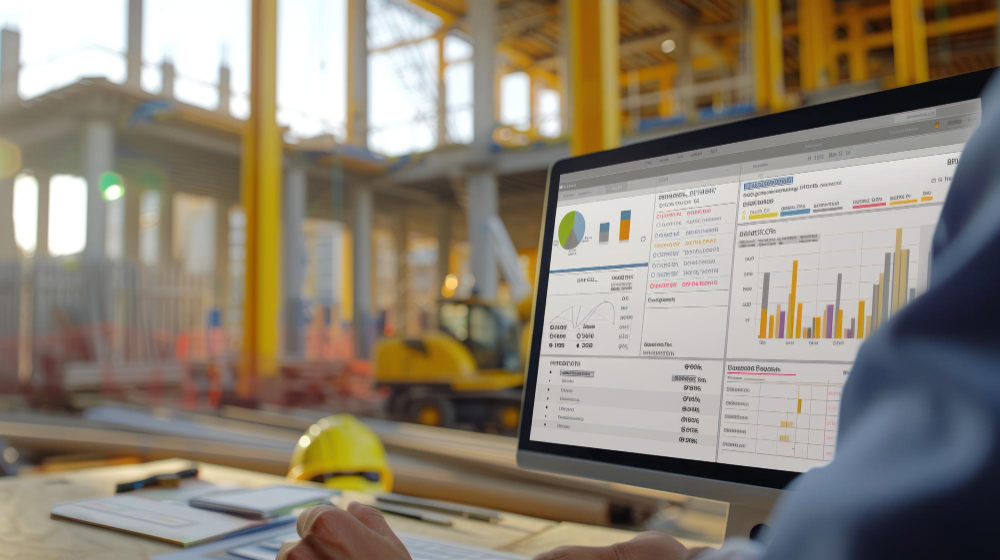
For decades, construction professionals relied on manual methods for preparing estimates. These methods still exist today, especially in small-scale projects, but they come with limitations.
Traditional Manual Estimating Methods
Manual estimating typically includes:
- Handwritten calculations
- Paper blueprints
- Printed takeoff sheets
- Basic calculators
- Spreadsheet tools like Microsoft Excel
Spreadsheets remain one of the most commonly used tools. They allow estimators to:
- Create cost breakdown structures
- Calculate labor and material costs
- Track overhead and contingency
- Adjust formulas easily
Advantages of Manual Methods:
- Low upfront cost
- Simple to use
- No training required for basic spreadsheets
- Flexible for small projects
However, manual methods are prone to:
- Human errors in formulas
- Version control issues
- Time-consuming quantity takeoffs
- Limited collaboration features
- Difficulty handling complex, large-scale projects
As projects become larger and more detailed, manual estimating becomes inefficient and risky.
Digital Estimating: The Modern Approach
Digital estimating tools use specialized software to automate calculations, improve accuracy, and streamline workflows. These tools can:
- Perform automated quantity takeoffs from digital blueprints
- Integrate cost databases
- Generate detailed reports
- Track revisions in real time
- Support collaboration across teams
Benefits of Digital Estimating Tools:
- Faster turnaround times
- Reduced calculation errors
- Real-time data updates
- Cloud-based collaboration
- Integration with project management and accounting systems
For large commercial projects, digital tools are no longer optional, they are essential. They enhance efficiency, improve bidding accuracy, and increase competitiveness.
Popular Estimating Software Solutions
Several professional tools dominate the construction estimating market. Let’s take a closer look at some of the most trusted solutions.
1. ProEst
ProEst is a cloud-based construction estimating platform designed for mid-size to large contractors.
Key Features:
- Digital takeoff capabilities
- Integrated cost database
- Real-time collaboration
- Detailed reporting and analytics
- Bid management tools
Why Contractors Choose ProEst:
ProEst is known for its scalability. It allows teams to work together remotely, which is especially helpful for companies managing multiple projects across locations.
It also integrates with accounting software, reducing duplication of data entry and improving financial accuracy.
Best For: Commercial contractors and enterprises managing large bids.
2. PlanSwift
PlanSwift specializes in digital quantity takeoff. It allows estimators to measure materials directly from electronic blueprints.
Key Features:
- Drag-and-drop takeoff tools
- Visual measurement tools
- Material and labor cost integration
- Customizable assemblies
Why Contractors Choose PlanSwift:
Speed and simplicity. Estimators can click on blueprint drawings and instantly calculate square footage, linear measurements, or material quantities.
This dramatically reduces manual measurement errors and improves productivity.
Best For: Contractors who focus heavily on accurate quantity takeoffs.
3. Sage Estimating
Sage Estimating is part of the Sage construction management ecosystem. It is widely used in large-scale and complex construction projects.
Key Features:
- Detailed cost databases
- Multi-user access
- Historical cost tracking
- Integration with Sage accounting systems
- Advanced reporting capabilities
Why Contractors Choose Sage Estimating:
It offers deep financial integration. Companies that already use Sage accounting software benefit from seamless cost tracking from estimate to project completion.
Sage Estimating is particularly strong in managing:
- Multi-phase projects
- Large commercial developments
- Infrastructure construction
Best For: Enterprise-level contractors and organizations needing financial system integration.
4. Bluebeam
Bluebeam is widely known for its PDF markup and collaboration capabilities, but it also serves as a powerful estimating support tool.
Key Features:
- Digital plan review
- Markup and measurement tools
- Real-time collaboration
- Quantity takeoff support
Why Contractors Choose Bluebeam:
Bluebeam allows teams to mark up drawings, highlight changes, and measure materials directly within PDF plans. It improves communication between estimators, engineers, and project managers.
While not a full estimating system like ProEst or Sage, it is an excellent complementary tool.
Best For: Design-build teams and contractors who need collaborative plan review tools.
Choosing the Right Estimating Tool
Selecting the right software depends on several factors:
- Project size and complexity
- Company budget
- Team size
- Integration needs
- Required reporting depth
Here’s a quick comparison:
| Software | Best For | Strength |
| ProEst | Large commercial contractors | Cloud collaboration |
| PlanSwift | Quantity takeoff specialists | Speed and visual measurement |
| Sage Estimating | Enterprise contractors | Accounting integration |
| Bluebeam | Design-build teams | Plan markup and collaboration |
The construction industry is becoming increasingly data-driven. While spreadsheets still serve a purpose, digital estimating software significantly improves:
- Accuracy
- Efficiency
- Transparency
- Profitability
Companies that adopt modern estimating tools gain a strong competitive advantage. In a market where profit margins are tight, precision matters.
For industry standards and best practices, refer to the American Society of Professional Estimators (ASPE).
Common Challenges in Construction Cost Estimating
Construction projects are complex, dynamic, and often unpredictable. Even the most experienced professionals can face obstacles during the estimating process. Understanding these challenges helps estimators prepare better strategies and reduce financial risks. Below are two of the most critical issues that frequently impact project accuracy and profitability.
Inaccurate Data and Scope Changes
One of the biggest challenges in construction cost estimating is relying on incomplete or inaccurate data. Estimators depend heavily on architectural drawings, engineering specifications, material lists, and labor productivity rates. If any of this information is missing, outdated, or unclear, the estimate can quickly become unreliable.
1. Incomplete Project Information
In the early stages of a project, plans may not be fully developed. Key details such as:
- Exact material specifications
- Structural dimensions
- Mechanical and electrical layouts
- Site conditions
may still be under review. Estimating costs based on assumptions instead of confirmed data increases the risk of significant budget gaps later.
For example, if soil testing reports are not finalized, foundation costs may be underestimated. Once accurate information becomes available, the budget may need major adjustments.
2. Frequent Design Revisions
Frequent design revisions can disrupt original estimates and create financial instability. Changes often occur due to:
- Client preferences
- Regulatory requirements
- Value engineering decisions
- Architectural improvements
Every time a design changes, the estimator must revise quantities, materials, labor hours, and equipment needs. This process takes time and increases the chance of errors.
For instance, switching from standard flooring to premium tile affects not only material costs but also installation time and labor rates. If these updates are not reflected promptly, the estimate becomes outdated.
3. Scope Creep
Scope creep refers to gradual, unapproved project expansions. Small additions—like extra lighting fixtures or upgraded finishes—can add up quickly. If these changes are not documented and re-estimated, they lead to cost overruns and disputes.
How to Minimize This Challenge?
- Conduct thorough scope reviews before estimating
- Maintain strong communication with architects and engineers
- Implement change order management systems
- Use updated project documentation at all times
Proactive coordination reduces surprises and improves estimate accuracy.
Market Fluctuations and Supply Chain Issues
Another major challenge in construction cost estimating is market instability. The construction industry is heavily influenced by global economic conditions, trade policies, fuel prices, and supply chain disruptions.
1. Material Price Volatility
Material price volatility significantly impacts cost forecasting. Prices of key materials such as:
- Steel
- Cement
- Lumber
- Copper
- Asphalt
can change rapidly due to market demand, transportation costs, or geopolitical events.
For example, during periods of high demand or limited supply, steel prices may surge dramatically. An estimate prepared months earlier may no longer reflect actual market conditions when procurement begins.
2. Supply Chain Disruptions
Supply chain interruptions can delay material delivery and increase costs. Common causes include:
- Port congestion
- Labor shortages
- International trade restrictions
- Natural disasters
Delays often result in extended project timelines, which increase labor costs, equipment rentals, and overhead expenses.
3. Labor Market Instability
In addition to materials, labor costs can fluctuate due to:
- Skilled worker shortages
- Wage inflation
- Regional labor demand
When labor supply is tight, contractors may need to offer higher wages, directly impacting project budgets.
How to Manage Market Risks?
- Regularly update material price databases
- Include escalation clauses in contracts
- Build contingency allowances into estimates
- Monitor industry reports and economic forecasts
- Develop relationships with multiple suppliers
By staying informed and flexible, estimators can reduce exposure to unexpected price spikes.
Best Practices for Accurate Cost Estimating
Accurate cost estimating is the backbone of every successful construction project. Even a small miscalculation can snowball into major budget overruns, strained relationships, and lost profits. That’s why professionals rely on proven best practices to improve precision and reliability.
Below are four essential best practices that can dramatically improve the accuracy of your construction cost estimates.

1. Maintain Updated Cost Databases
One of the most powerful tools in accurate cost estimating is a well-maintained and regularly updated cost database. Construction markets change fast. Material prices fluctuate, labor rates increase, fuel costs vary, and supply chain disruptions can impact availability.
If your database is outdated, your estimate will be too.
Why Updated Databases Matter?
- Reflect Real-Time Market Conditions: Steel, lumber, and concrete prices can change monthly—or even weekly.
- Improve Bid Competitiveness: Accurate pricing ensures you don’t overbid or underbid.
- Enhance Profit Margins: Proper pricing reduces unexpected cost gaps.
What Should Be Updated?
Your cost database should include:
- Material unit costs
- Labor productivity rates
- Equipment rental rates
- Subcontractor pricing
- Overhead percentages
How to Keep It Updated?
- Subscribe to construction cost index reports.
- Review supplier quotes regularly.
- Track actual project expenses and compare them with estimated values.
- Update labor rates annually or whenever contracts change.
Pro tip: Many professional estimating software solutions allow automatic cost database updates. Leveraging digital tools can significantly reduce human error.
In short, an updated cost database ensures your numbers reflect reality—not last year’s assumptions.
2. Use Historical Data for Benchmarking
If you’ve completed similar projects before, you’re sitting on a goldmine of valuable information. Historical data helps estimators identify patterns, compare performance, and refine future projections.
Think of it as learning from experience—because that’s exactly what it is.
Benefits of Historical Benchmarking
- Improves estimate accuracy over time
- Identifies cost trends and recurring challenges
- Helps validate new project estimates
- Speeds up conceptual estimating
For example, if your past commercial office project cost $150 per square foot, you can use that data as a baseline when estimating a similar project. Of course, adjustments must be made for inflation, location, and design complexity.
How to Use Historical Data Effectively?
- Categorize projects by type (residential, commercial, industrial).
- Record actual costs vs estimated costs.
- Analyze variances and identify causes.
- Adjust future estimates based on lessons learned.
Consistency is key. The more organized your records, the more reliable your benchmarking becomes.
Historical data transforms estimating from guesswork into data-driven forecasting.
3. Collaborate with Engineers and Architects
Cost estimating should never happen in isolation. Collaboration with engineers, architects, and project stakeholders leads to more comprehensive and realistic cost projections.
Why? Because design decisions directly impact costs.
How Collaboration Improves Accuracy?
- Engineers clarify structural complexities.
- Architects explain design intent and material selections.
- Project managers identify construction constraints.
- Procurement teams provide supplier insights.
For example, a minor design change, like switching from standard windows to custom glazing, can significantly increase costs. Early communication prevents surprises.
Best Collaboration Practices
- Conduct joint design review meetings.
- Involve estimators early in the planning phase.
- Encourage open communication about design changes.
- Use Building Information Modeling (BIM) for real-time updates.
When estimators understand the technical details behind drawings, they can produce far more accurate cost breakdowns.
Teamwork doesn’t just improve efficiency, it strengthens financial predictability.
4. Conduct Risk Assessments Regularly
Construction projects are full of uncertainties. Weather delays, regulatory changes, labor shortages, and supply disruptions can all impact project costs.
That’s why regular risk assessments are essential for accurate cost estimating.
Why Risk Assessment Is Critical?
- Reduces unexpected budget overruns
- Improves contingency planning
- Increases stakeholder confidence
- Enhances financial stability
Without proper risk evaluation, estimates can be overly optimistic, and that’s dangerous.
Steps to Conduct Effective Risk Assessments
- Identify potential risks (market volatility, site conditions, regulatory changes).
- Evaluate the probability of each risk.
- Estimate the financial impact.
- Allocate appropriate contingency funds.
- Review risks periodically throughout the project lifecycle.
For example, if a project depends heavily on imported materials, you must account for potential shipping delays or tariff changes.
Many experienced estimators allocate 5–15% contingency based on project complexity and risk profile.
Risk assessment isn’t about expecting failure, it’s about preparing for reality.
Conclusion
Understanding What is Construction Cost Estimating is essential for anyone involved in construction projects. Accurate estimating ensures profitability, reduces risks, strengthens competitive bidding, and builds trust among stakeholders.
In today’s complex construction environment, mastering cost estimating techniques is no longer optional, it’s critical.
Frequently Asked Questions (FAQs)
-
What is Construction Cost Estimating in simple terms?
It is the process of predicting how much a construction project will cost before work begins.
-
Why is construction cost estimating important?
It prevents budget overruns and ensures financial feasibility.
-
What are the main types of cost estimates?
Preliminary, detailed, quantity takeoff, bid, control, parametric, and analogous estimates.
-
Who prepares construction cost estimates?
Professional cost estimators, contractors, or project managers.
-
What tools are used in cost estimating?
Software like ProEst, Sage, and Bluebeam.
-
How accurate should a construction estimate be?
Detailed estimates aim for 95–99% accuracy depending on project stage.
About The Author
